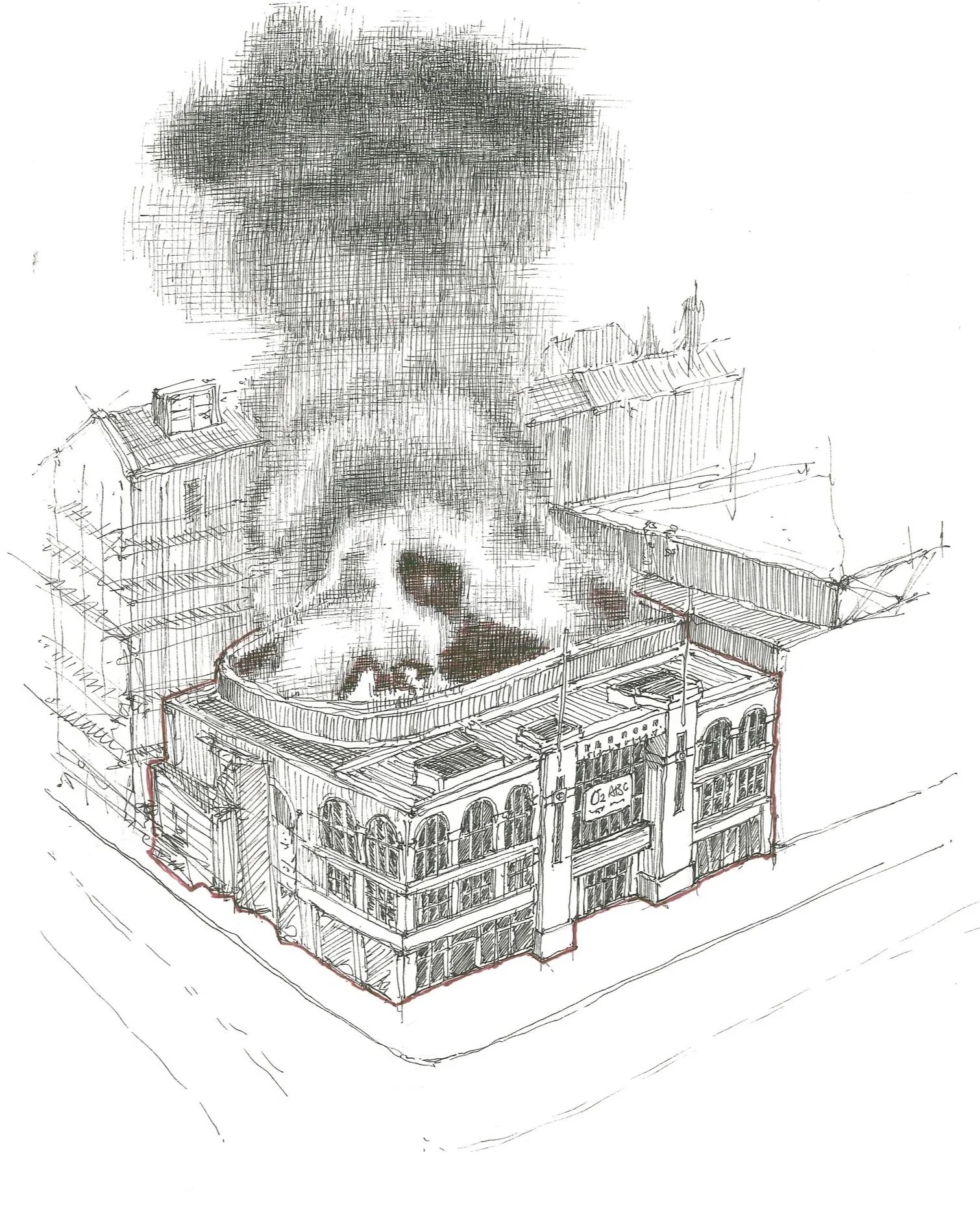
The following is the research stage of the design thesis, The Musical Microcosm, which seeks to investigate the needs of the music community in Glasgow, addressing the loss of its musical heritage due to the degradation of musical trades, loss of informal musical learning, threat to grassroots culture, and the destruction of cultural buildings. The recent demolition of Glasgow’s iconic musical centrepiece, the O2 ABC, looms heavily over the city. With the ABC being one of many heritage buildings lost to the council’s political agendas, its public destruction represents a larger issue in the music community; that heritage is being wilfully lost through architecture to make way for counter-cultural architectural proposals. The thesis therefore examines three lines of inquiry to answer the question: How can architecture support the reclamation of Glasgow’s musical heritage?
CITY OF SOUND
2024, Ink on Paper
The following is the research stage of the design thesis, The Musical Microcosm, which seeks to investigate the needs of the music community in Glasgow, addressing the loss of its musical heritage due to the degradation of musical trades, loss of informal musical learning, threat to grassroots culture, and the destruction of cultural buildings. The recent demolition of Glasgow’s iconic musical centrepiece, the O2 ABC, looms heavily over the city. With the ABC being one of many heritage buildings lost to the council’s political agendas, its public destruction represents a larger issue in the music community; that heritage is being wilfully lost through architecture to make way for counter-cultural architectural proposals. The thesis therefore examines three lines of inquiry to answer the question: How can architecture support the reclamation of Glasgow’s musical heritage?
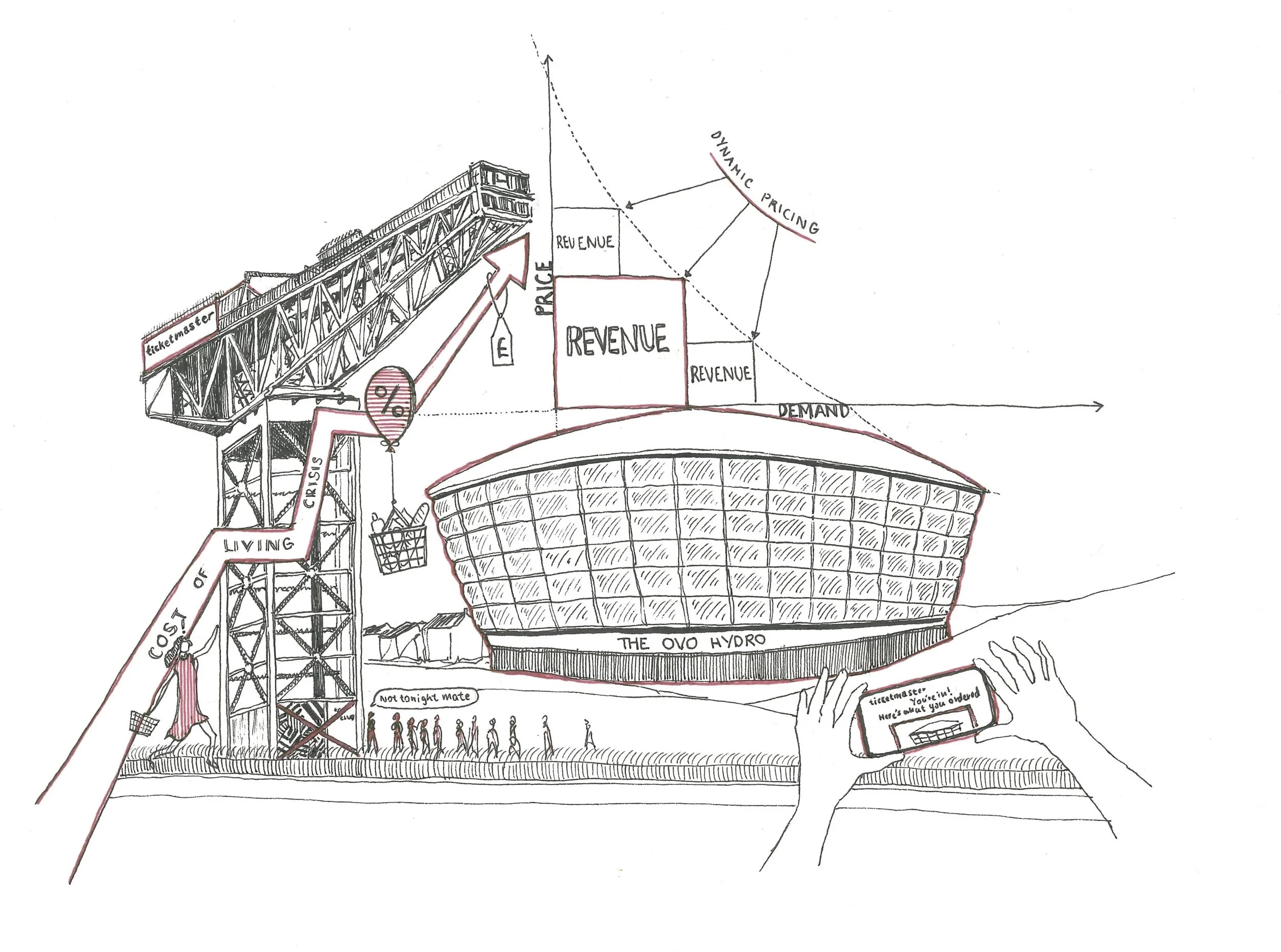
Several key trends have caused struggles for grassroots venues, musicians and even fans. A shift in scale is the common denominator: stadium shows have risen in popularity as artists can charge more and fit more fans in. This is largely due to event companies like Ticketmaster, who control mandatory charges on tickets; causing musicians to earn less, and concert goers to pay more. The increased use of the dynamic pricing model (as opposed to static) has contributed to people paying as much as game consoles for a single ticket, which highlights the financial inaccessibility of the music scene in the modern day. The move away from the small venue, paired with current cost of living issues, has forced numerous venues to closure.
Several key trends have caused struggles for grassroots venues, musicians and even fans. A shift in scale is the common denominator: stadium shows have risen in popularity as artists can charge more and fit more fans in. This is largely due to event companies like Ticketmaster, who control mandatory charges on tickets; causing musicians to earn less, and concert goers to pay more. The increased use of the dynamic pricing model (as opposed to static) has contributed to people paying as much as game consoles for a single ticket, which highlights the financial inaccessibility of the music scene in the modern day. The move away from the small venue, paired with current cost of living issues, has forced numerous venues to closure.
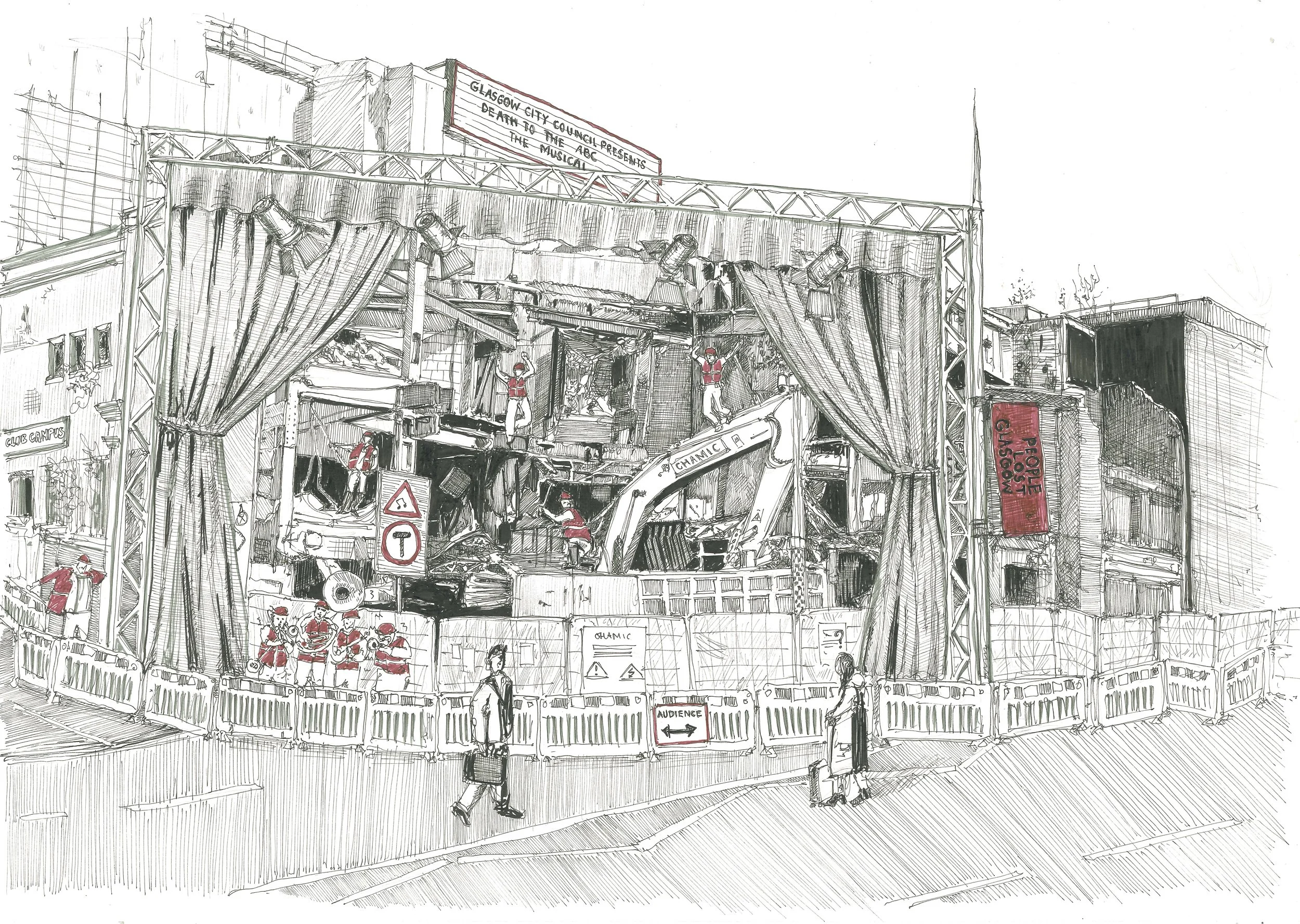
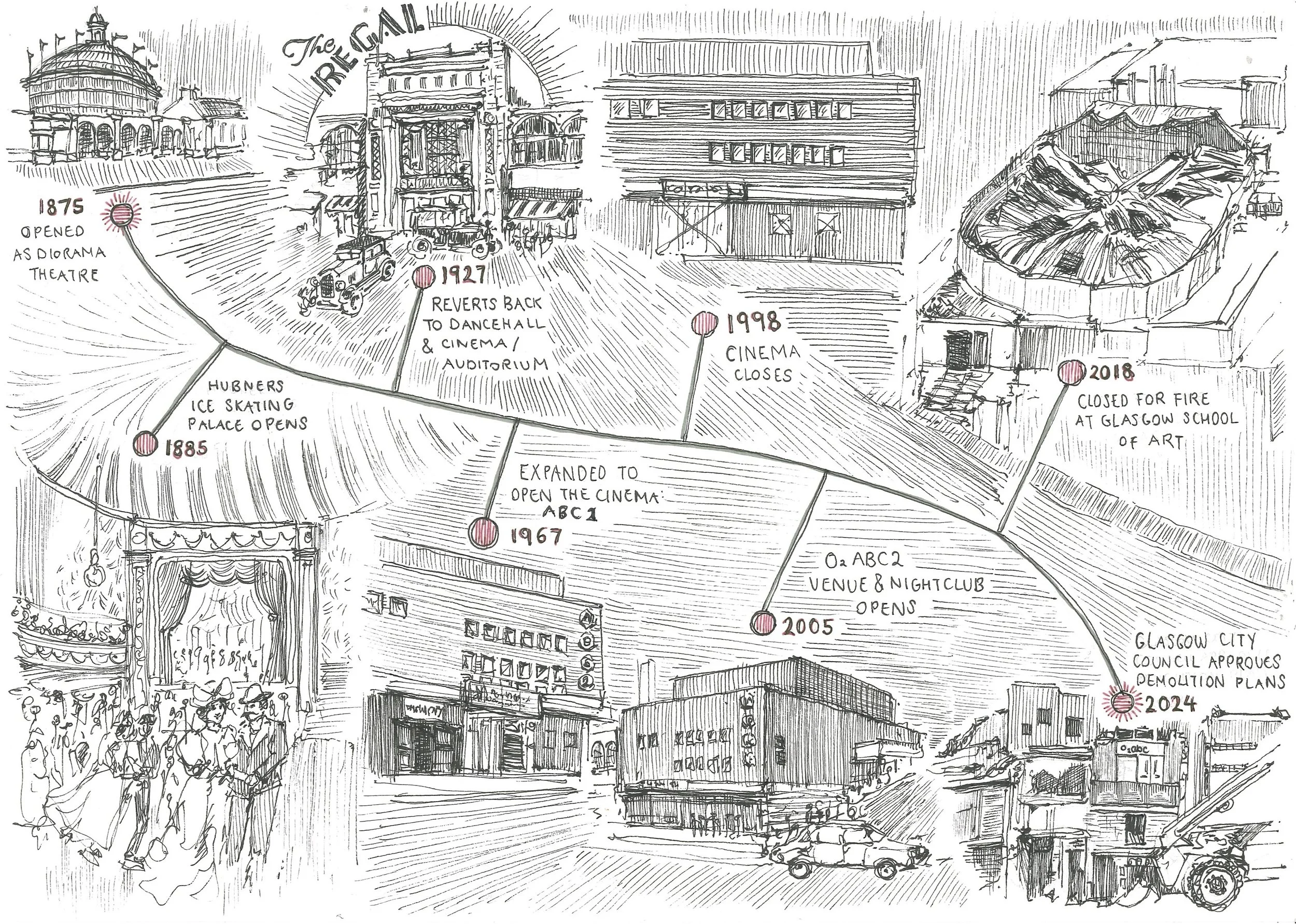
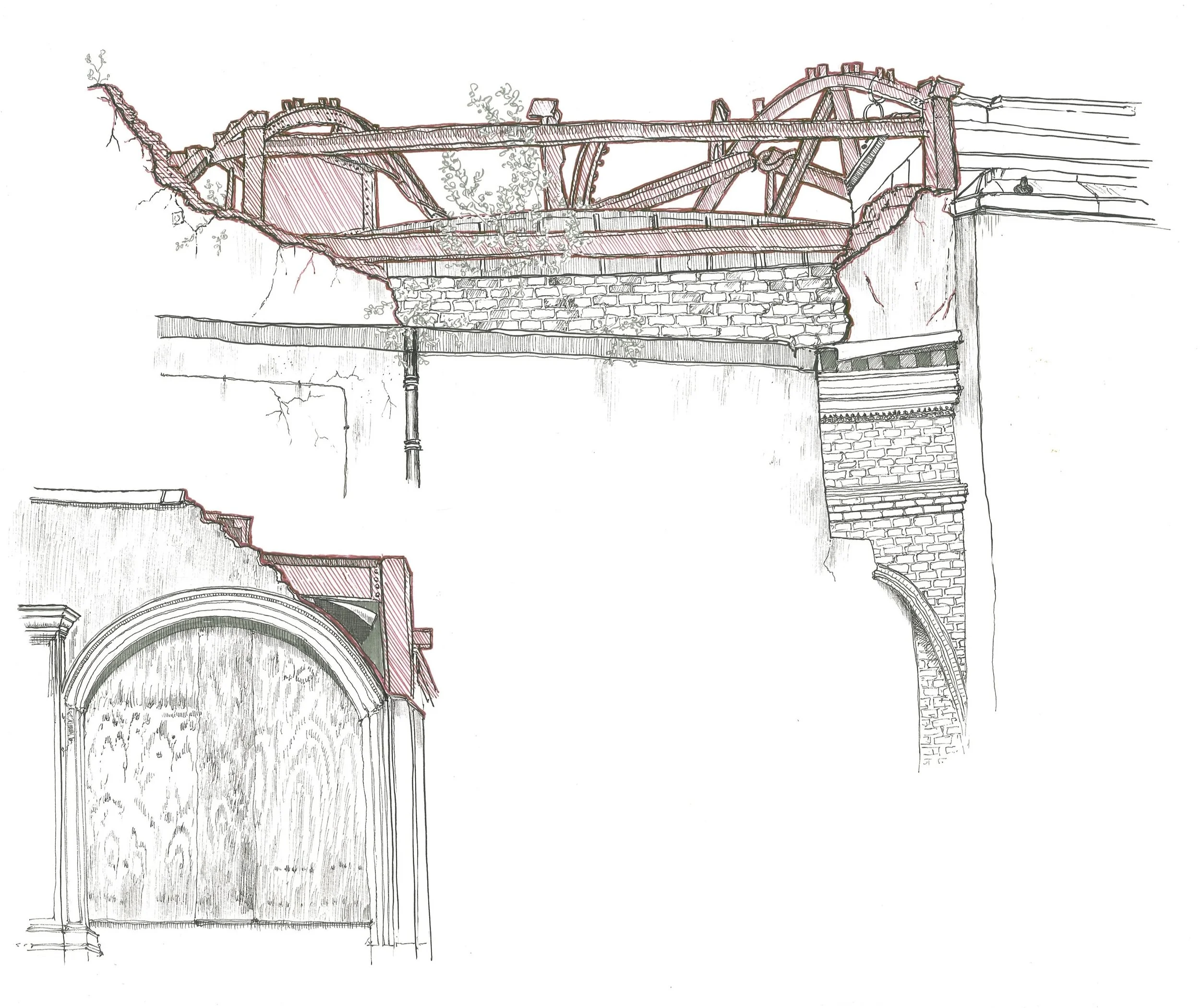
After serving its community for almost 150 years as an entertainment space, the council approved the ABC’s demolition this year, despite being declared structurally sound and being advised to retain the outer facade at the very least. Having gone through many design iterations, some positive and some careless (refer to log for architectural timeline), it felt only right to study the ABC in its current state; ruined. These detail studies of selected moments of decay and structural exposure helped highlight its physical vulnerability; a vulnerability on display for the whole city to see.
After serving its community for almost 150 years as an entertainment space, the council approved the ABC’s demolition this year, despite being declared structurally sound and being advised to retain the outer facade at the very least. Having gone through many design iterations, some positive and some careless (refer to log for architectural timeline), it felt only right to study the ABC in its current state; ruined. These detail studies of selected moments of decay and structural exposure helped highlight its physical vulnerability; a vulnerability on display for the whole city to see.
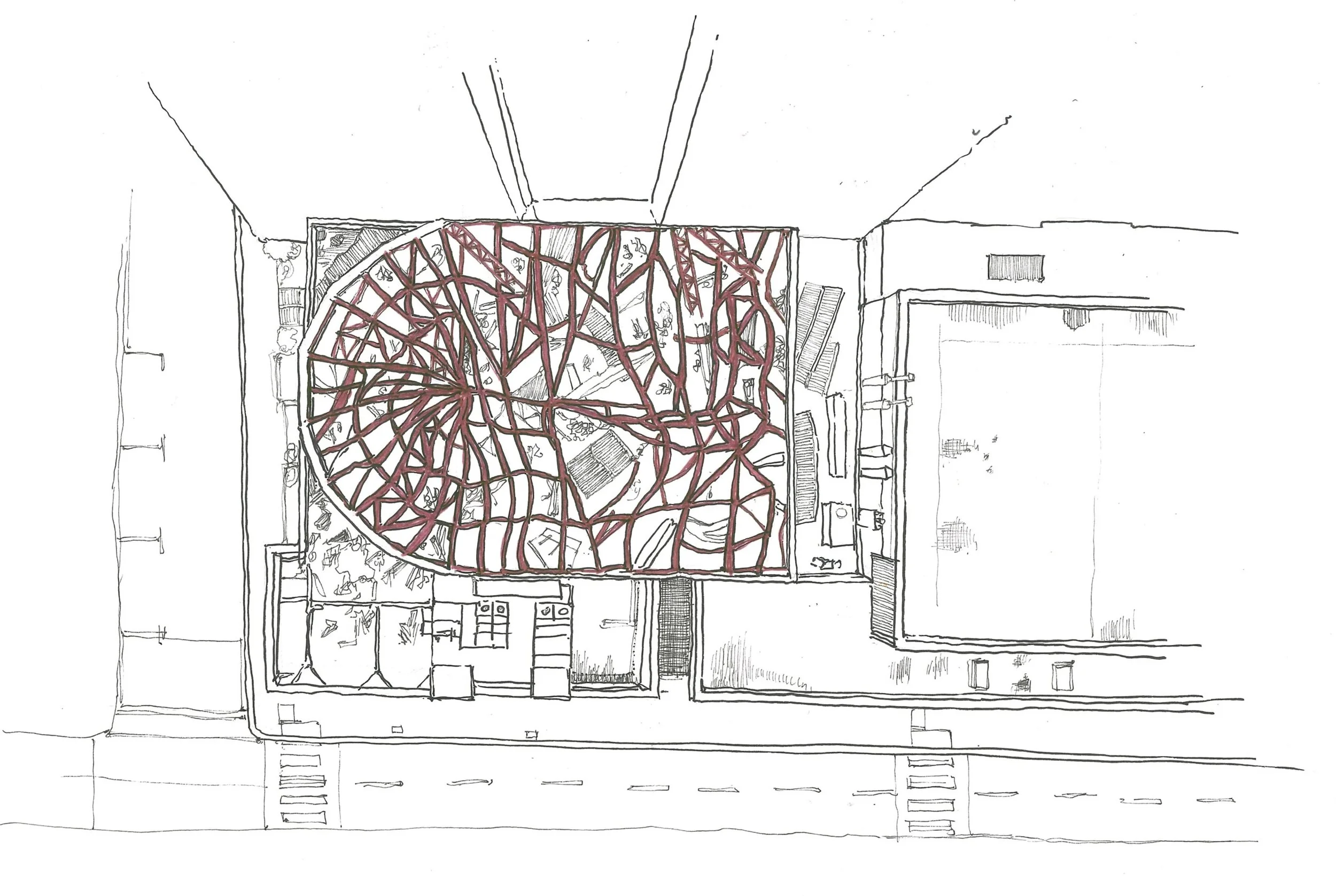
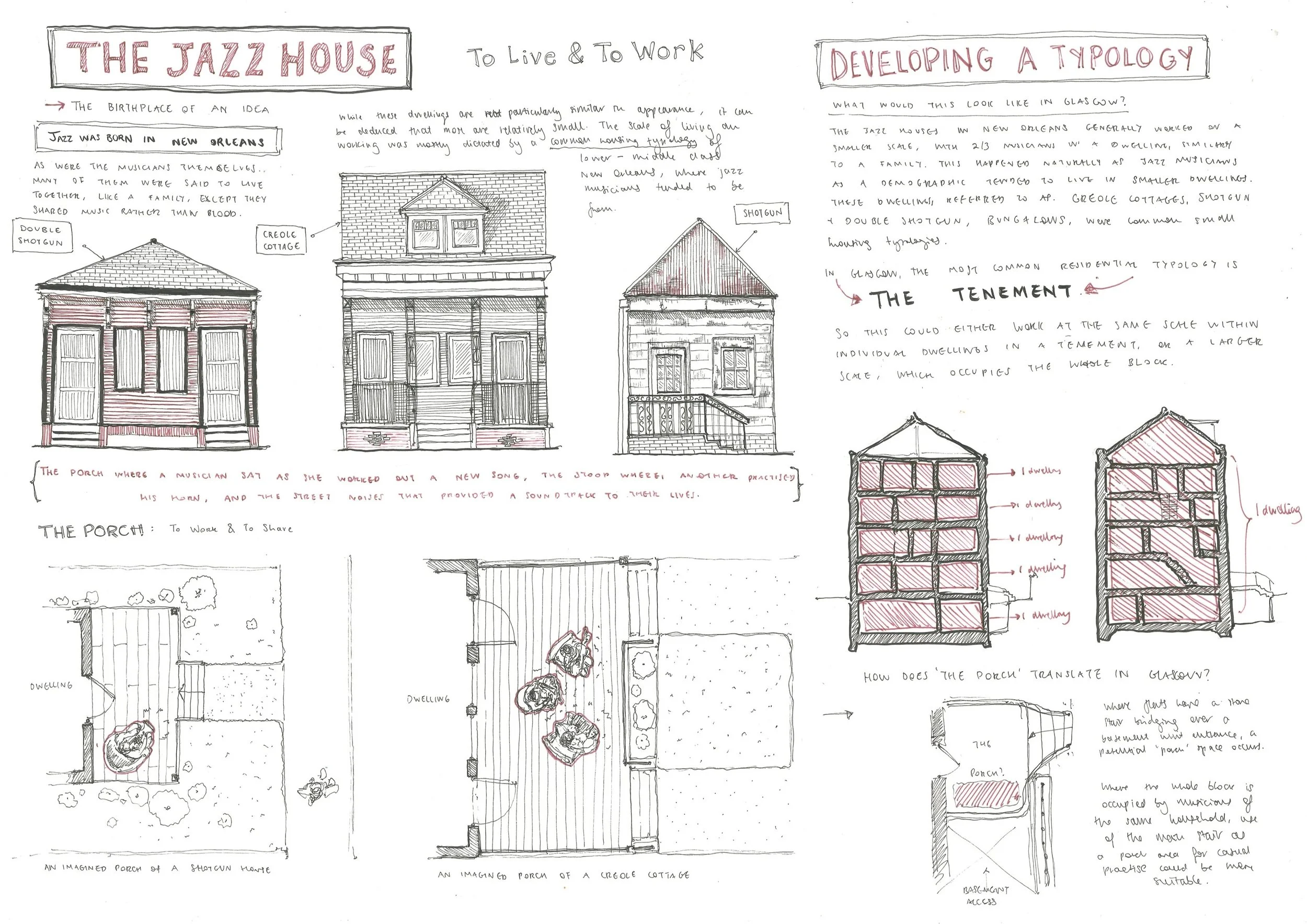
The jazz house in Glasgow is based on the small scale house share concept amongst musicians but imagined on a larger scale. The proposition to be tested is a musical living and working typology that fits into Glasgow’s most common residential typology: the tenement. This line of inquiry hypothesises that this new mode of living would help support young, struggling, or grassroots musicians. Living in close quarters to other musicians of different skills could help individuals grow educationally and socially.
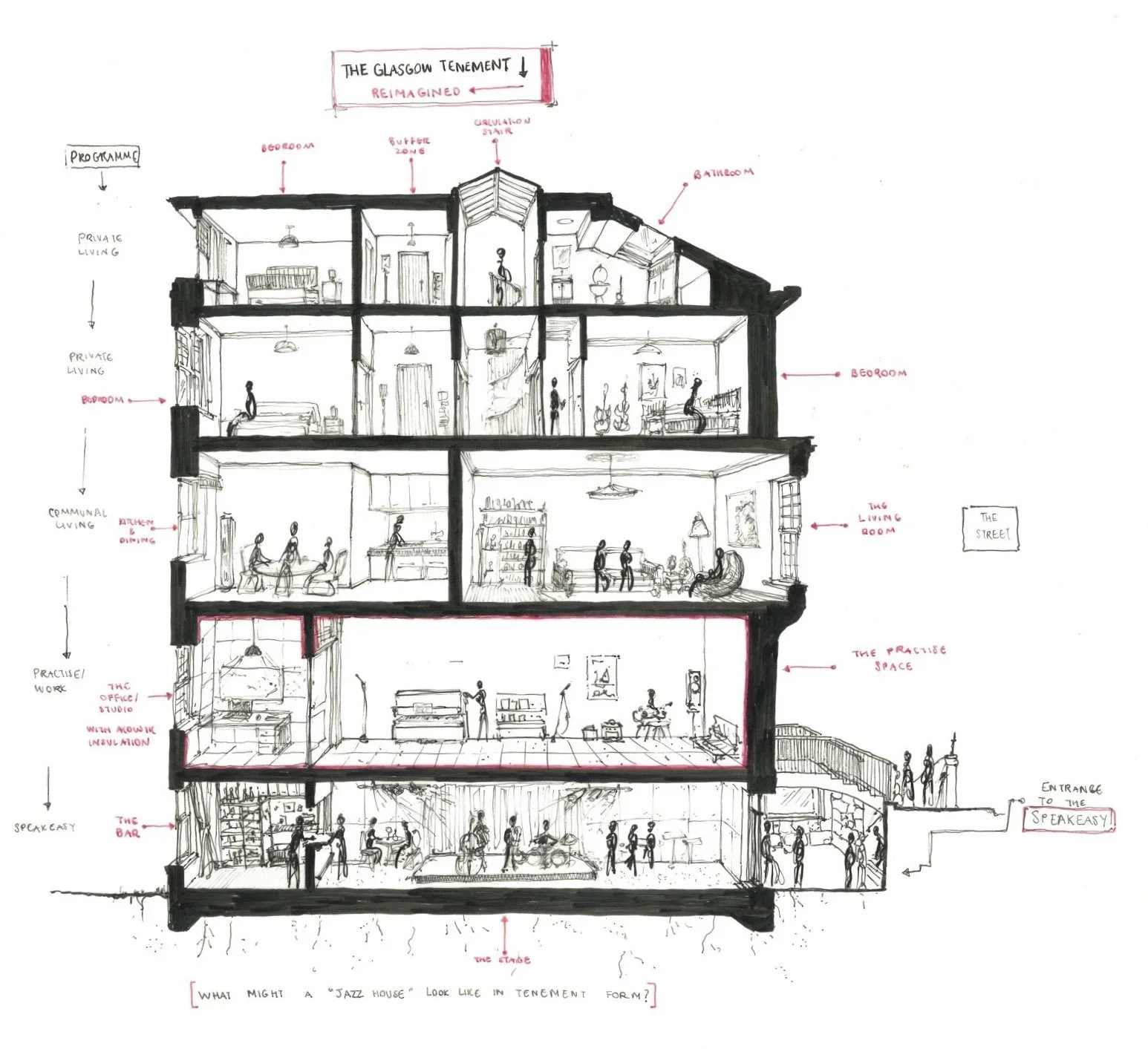
Envisioning the uses and musical/daily activities that the jazz house might accommodate, tested the concept’s full application in a tenement format. This led to thoughts about acoustics, accessibility and longevity which would need to be considered in detail for the inquiry to be progressed.
Drawing inspiration from New Orleans jazz culture, the concept of a “jazz house” is proposed. This refers to a grassroots typology where musicians live, play and collaborate in one dwelling. A key aspect of this involves connecting informal performance with the external environment, that being the street. This concept is applied contextually to Glasgow to test whether it could potentially improve musicians’ educational, social and financial wellbeing whilst increasing public engagement.
Drawing inspiration from New Orleans jazz culture, the concept of a “jazz house” is proposed. This refers to a grassroots typology where musicians live, play and collaborate in one dwelling. A key aspect of this involves connecting informal performance with the external environment, that being the street. This concept is applied contextually to Glasgow to test whether it could potentially improve musicians’ educational, social and financial wellbeing whilst increasing public engagement.
The jazz house in Glasgow is based on the small scale house share concept amongst musicians but imagined on a larger scale. The proposition to be tested is a musical living and working typology that fits into Glasgow’s most common residential typology: the tenement. This line of inquiry hypothesises that this new mode of living would help support young, struggling, or grassroots musicians. Living in close quarters to other musicians of different skills could help individuals grow educationally and socially.
Envisioning the uses and musical/daily activities that the jazz house might accommodate, tested the concept’s full application in a tenement format. This led to thoughts about acoustics, accessibility and longevity which would need to be considered in detail for the inquiry to be progressed.
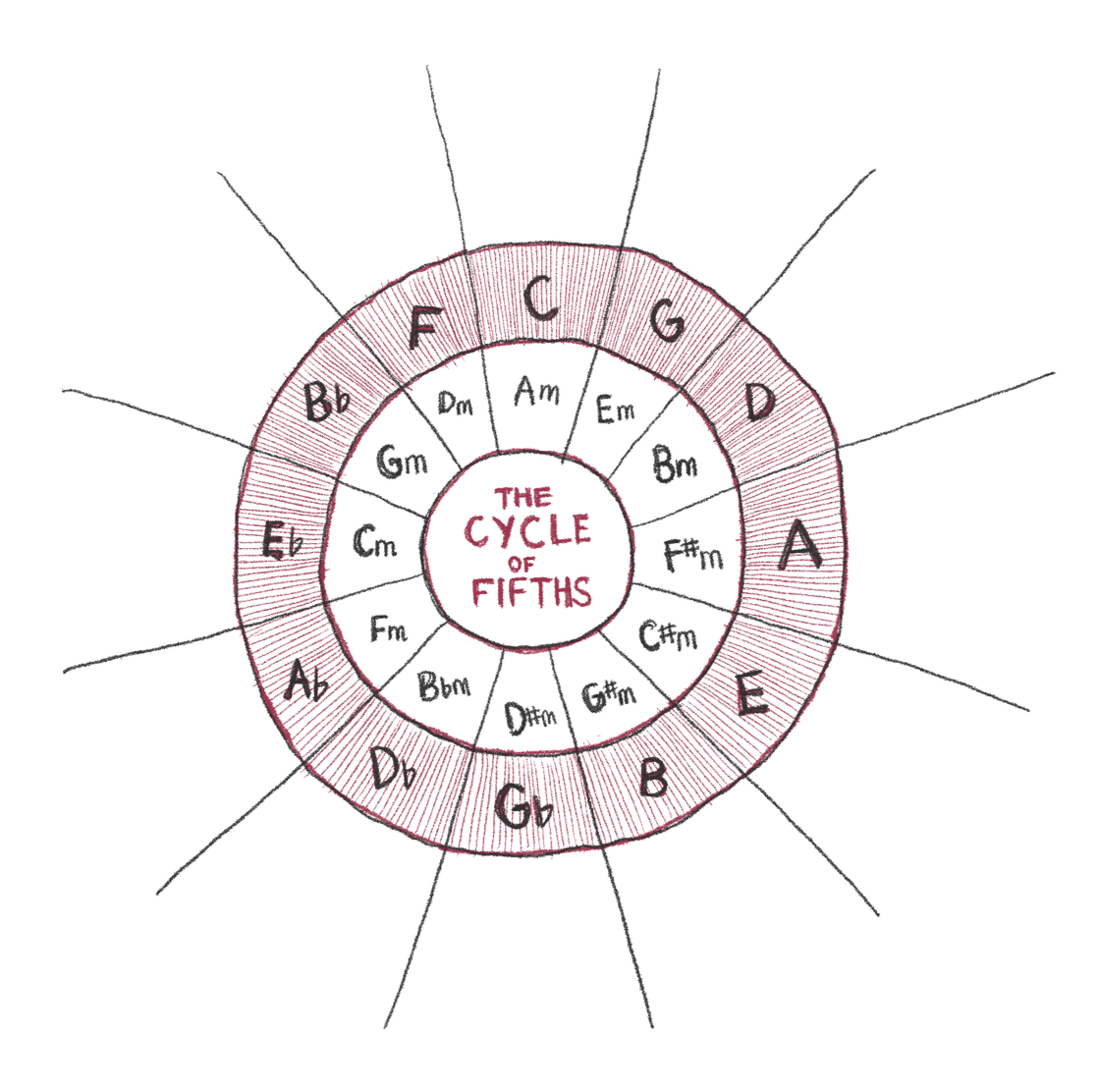
The industry mending programme is a series of objectives rather than functions, inspired by the cycle of fifths. The cycle of fifths is a system of key signatures used in music theory, typically jazz, as understanding the system thoroughly helps immensely with improvisation. The arrangement of the system is based on the increments of “fifths” ascending the key signatures. A fifth, in music theory, refers to the interval between two notes. For example, the interval between C and G is referred to as a fifth. Certain intervals sound more harmonic than others, and similarly, some chords sound better in sequence than others. Ultimately, the system is used to understand what makes a good melody, harmony, and composition. Between music and architecture, the notion of composition can be related to the notion of design; construction.
To address the disconnect between musicians and musical tradespeople, the programme sees technical spaces such as an instrument making studio and piano technician’s studio, next to musicians performing or practising. The instruments used in the system will be used and worked on by everyone in the community, meaning individuals will need to work with one another and form relationships.
The industry mending programme is a series of objectives rather than functions, inspired by the cycle of fifths. The cycle of fifths is a system of key signatures used in music theory, typically jazz, as understanding the system thoroughly helps immensely with improvisation. The arrangement of the system is based on the increments of “fifths” ascending the key signatures. A fifth, in music theory, refers to the interval between two notes. For example, the interval between C and G is referred to as a fifth. Certain intervals sound more harmonic than others, and similarly, some chords sound better in sequence than others. Ultimately, the system is used to understand what makes a good melody, harmony, and composition. Between music and architecture, the notion of composition can be related to the notion of design; construction.
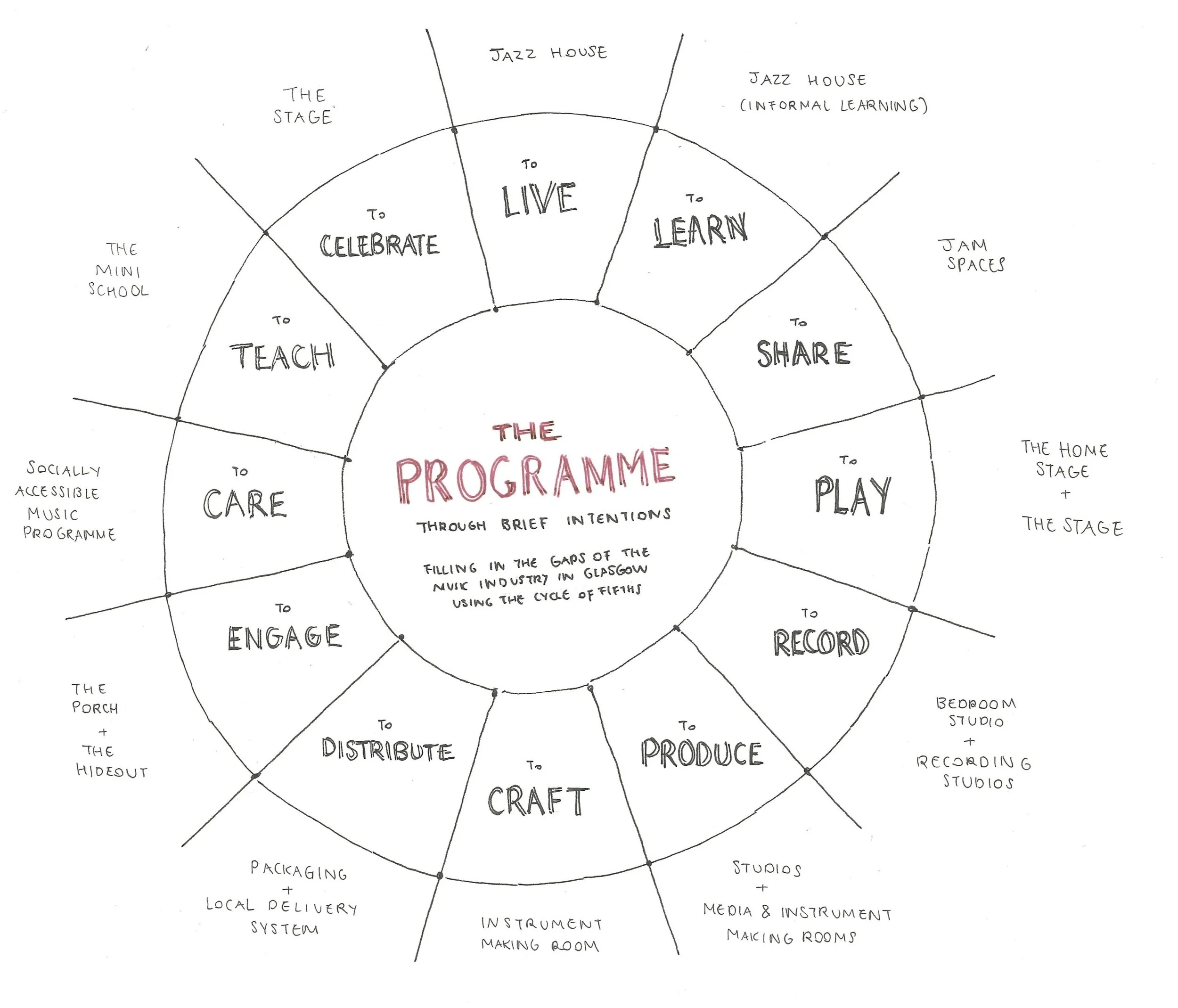
To address the disconnect between musicians and musical tradespeople, the programme sees technical spaces such as an instrument making studio and piano technician’s studio, next to musicians performing or practising. The instruments used in the system will be used and worked on by everyone in the community, meaning individuals will need to work with one another and form relationships.
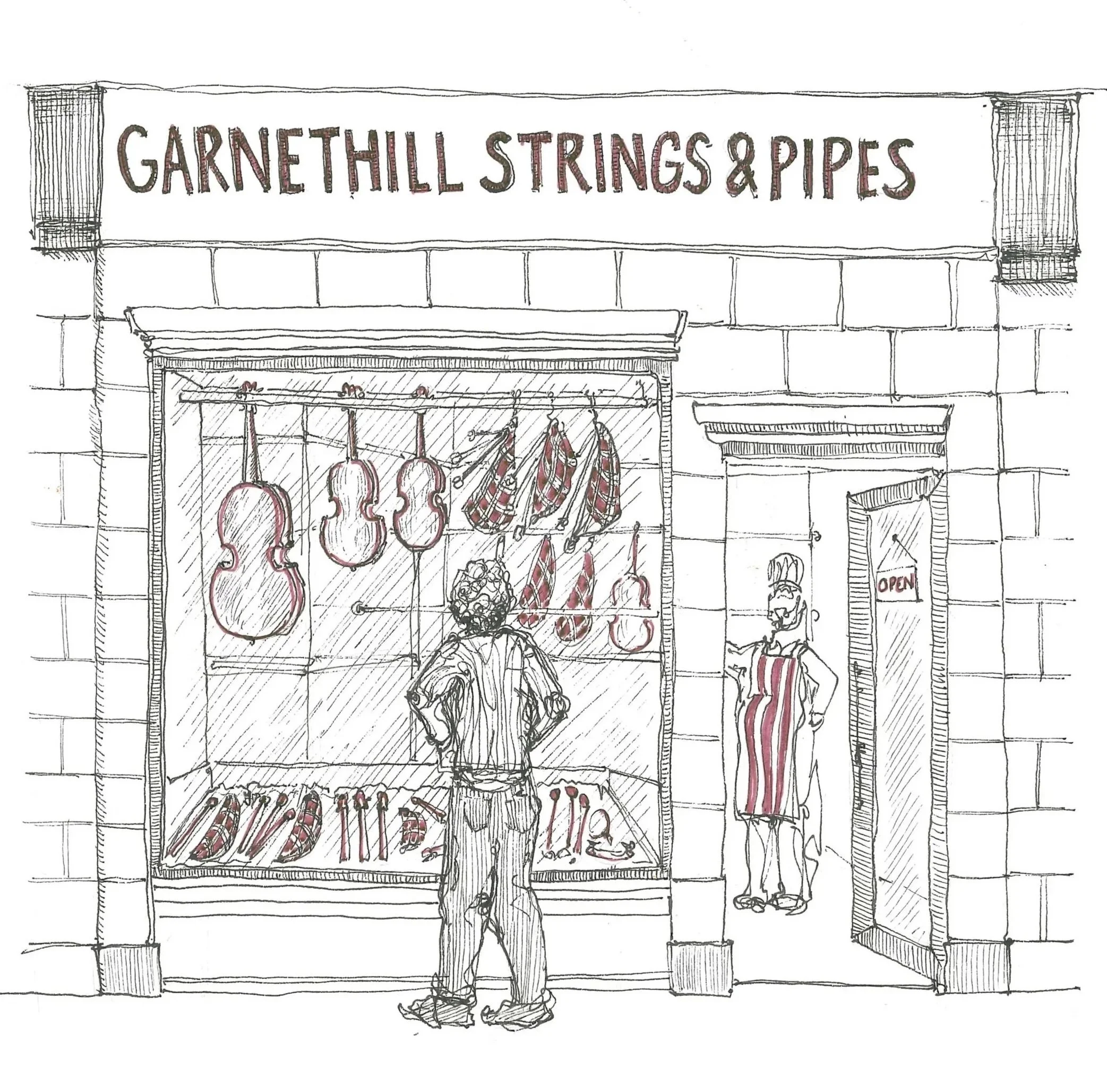
The other key aspect of the cycle is engaging with the public; gaining exposure. The illustration reimagines a high street butchershop as a shop selling instrument parts instead of animal parts. It relies on the notion that all creativity should be put on show, and by doing so, gives businesses a bigger audience.
The other key aspect of the cycle is engaging with the public; gaining exposure. The illustration reimagines a high street butchershop as a shop selling instrument parts instead of animal parts. It relies on the notion that all creativity should be put on show, and by doing so, gives businesses a bigger audience.